Real Science

Tuesday, 11 December 2007

Fresh water from the nucleus

Inderscience: Embargoed for release: 20-Nov-2007 00:15 Eastern US

The discovery of an environmentally friendly way to take salt out of seawater would be a major breakthrough for the world. Fresh, clean drinking water wherever it is needed would save lives, promote good health and even prevent war.


More than 3.5 billion people will be living in areas of severe water shortage by 2025. Climate change, desertification and over-population are all reducing fresh water supplies. Fresh water could soon become a rare and expensive commodity.

India faces a rapidly increasing demand for fresh water. This is driven by a growing population and by agricultural and industrial expansion.

New solutions to the old problem of getting fresh water supplies were explored at the Trombay Symposium on desalination and Water Reuse. These have now been published in a special issue of the International journal of Nuclear Desalination (IJND).

The methods of desalination that are used now are expensive and inefficient. There are a number of alternatives.

Pradip Tewari (of the desalination Division at Bhabha Atomic Research Centre, Mumbai) suggests a holistic approach. This would include seawater desalination in coastal areas, brackish water desalination and rainwater harvesting. This last is particularly useful in the monsoon season.

"The contribution of seawater and brackish water desalination would play an important role in augmenting the freshwater needs of the country," Tewari says.

Meenakshi Jain (CDM & Environmental Services and Positive Climate Care Pvt Ltd in Jaipur) draws attention to the energy problem. "Desalination is an energy-intensive process," he says.

Fossil fuels are only a short-term answer. In the long term, "desalination with fossil energy sources would not be compatible with sustainable development."

Fossil fuel reserves are finite, he adds, and "must be conserved for other essential uses". But the demand for desalted water will continue to rise.

A sustainable solution to water shortages that does not cause pollution is essential, Jain points out. Renewable energy technologies such as wind, solar and wave power, could be used to a limited extent to generate electricity and desalinate seawater.

But nuclear energy is the most promising technology. "Nuclear energy seawater desalination has a tremendous potential for the production of freshwater," Jain says.

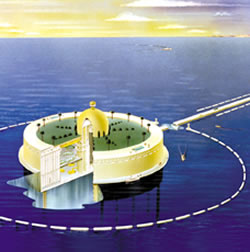
A floating nuclear plant is one of the most flexible approaches, says S.S. Verma (Department of Physics at SLIET in Punjab). Small floating plants could produce electrical energy with very little pollution or greenhouse gas emissions.

These plants could be placed offshore wherever there is dense population on the coast. They would provide cheap electricity and, at the same time, use their waste heat to run a desalination plant. "Companies are already in the process of developing a special desalination platform for attachment to floating nuclear power plants," Verma says.

Another approach is low temperature evaporation (LTE) desalination technology. This can produce very pure water from seawater using either warm water (as low as 50 Celsius) or low-pressure steam from a nuclear power plant.

LTE has already been shown to be safe, reliable and relatively cheap, says A. Raha (desalination Division of the Bhabha Atomic Research Centre (BARC),Trombay).

This Centre recently commissioned a 50 tonnes-per-day, low-temperature desalination plant, he points out.

Solar, wind and wave power might seem effective for desalination, says co-editor of the journal, B.M. Misra. He is a former head of BARC. But these methods can't be used for large-scale production of freshwater. And this is what an increasingly industrial and growing population needs.

India already has plans to expand its nuclear power industry. Misra suggests that large-scale desalination plants could easily be included in those plans.

"The development of advanced reactors providing heat for hydrogen production and large amounts of waste heat will catalyse the large-scale seawater desalination for economic production of fresh water."

###

International journal of Nuclear desalination, 2007, volume 2, issue 4

More help with words

atom

element

energy

environment

fossilised

nucleus

nuclear

population


What's it all about?

  1. Can people drink seawater?
  2. What can be done to seawater to make it drinkable?
  3. The story mentions three reasons more people will struggle to find fresh drinking water in future. State two of them.
  4. What was the Trombay Symposium all about?
  5. What does desalination mean?
  6. The article mentions a number of problems with existing methods of desalination (not all in the same place in the story). Find three of these problems.
  7. Besides desalinating seawater what else does Tewari suggest?
  8. What two words in the story tell you that desalination uses a lot of energy?
  9. What are fossil fuels?
  10. Give two reasons they shouldn't be used for large-scale production of fresh water.
  11. What does Jain believe is the most promising technology for producing fresh water?
  12. A small floating nuclear plant could do two jobs at the same time. What are they?
  13. LTE desalination is existing technology, which currently works using warm water. What could be used from a nuclear power plant with an LTE?
  14. Solar, wind and wave power might seem attractive for desalination. But they can't be used for "large-scale production of freshwater". Why not?
  15. Think of one question about desalination raised but not answered by this story.
  16. How could you find an answer to that question?

More science teaching resources for this story

Nuclear freshwater UK US


Topic for discussion, research or pupil presentations

As is evident from the previous activity this news story is not so much about new findings or developments, but about possible new applications of existing and cutting-edge technology. It is much more about issues and applications than the average science research story.

Here are some of these taken straight from the text:

  1. Fresh, clean drinking water wherever it is needed would save lives, promote good health and even prevent war.
  2. Climate change, desertification and over-population are all reducing fresh water supplies.
  3. The contribution of seawater and brackish water desalination would play an important role in augmenting the freshwater needs of the country.
  4. Fossil fuel reserves are finite, and "must be conserved for other essential uses". But the demand for desalted water will continue to rise.
  5. Nuclear energy seawater desalination has a tremendous potential for the production of freshwater.
  6. Small floating nuclear plants could produce electrical energy with very little pollution or greenhouse gas emissions.
  7. Solar, wind and wave power might seem effective for desalination. But these methods can't be used for large-scale production of freshwater.


And here are some possible topics for group discussion, research or presentations arising directly from the above. Students should be encouraged to think of others themselves.

  1. "Prevent war" – really? Working in groups, students should carry out a short research project on the Internet and present their findings to the class. They could start by searching for "water wars".
  2. A number of solutions, particularly nuclear, are presented in this article to the problem of rising demand for fresh water. All these are aimed at increasing the supply. Would it be more practical to stop the demand rising further by tackling one or all of climate change, desertification and over-population? Research, discuss and present.
  3. Research the numbers. What is the demand for fresh water? How fast is it growing? What will the situation be in 2020 if current trends continue? What sort of numbers look possible from seawater, brackish water and rainwater harvesting? Some of the statistics for this activity may have been obtained in Topic 1.
  4. Fossil fuels are used in many ways, from transport and heating to pharmaceuticals and plastics. In the students' opinions what are the "essential uses" for fossil fuels?
  5. Nuclear desalination has tremendous potential but any technology comes with risks. What are they? What is the downside of nuclear desalination? Draw up a column of these risks and another column with the risks of not using nuclear. Decide.
  6. Some anti-nuclear campaigners deny that nuclear energy produces very little pollution or greenhouse gases. Who is right? Investigate. Find actual numbers in terms of tonnes of nuclear waste and tonnes of waste produced by other sources of energy.
  7. What are the problems with using solar, wind and wave technologies for large-scale production of energy or desalination?


Tips for science class discussions and groupwork

No 64

What's the magic of stories? People love stories. Stories put learning into context. Lectures often don't do this. They are abstract with mountains of facts. … Even the redoubtable Richard Feynman spoke of his frustration with science education in the preface to his Lectures in Physics saying, "I think the system is a failure." He summarised, "The best teaching can be done only when there is a direct individual relationship between a student and a good teacher –a situation in which the student discusses the ideas, thinks about the things, and talks about the things. It is impossible to learn very much simply by sitting in lectures."

Herreid, C.F. (2007) Start with a Story: The Case Study Method of Teaching College Science. Arlington, Virginia: NSTA Press


Saturday, 24 November 2007

Cinnamon genes


Cold Spring Harbor Laboratory: Embargoed for release: 31-Oct-2007 17:00 Eastern US Time

Cinnamon genes

The cat genome has been sequenced for the first time. Scientists used samples taken from a four-year-old Abyssinian cat called Cinnamon. The report appears in Genome Research (www.genome.org).

Cinnamon is one of several mammals now being studied using a new method called light genome sequencing. The research team started with Cinnamon’s raw sequence data. Then scientists at a number of centres worked together. They used information from the genomes of other mammals that had been sequenced, together with earlier studies of the cat.

Six other mammal genomes have recently been completed. They are the human, chimpanzee, mouse, rat, dog, and cow. The human genome was finally sequenced in February 2001.

Similarities between the cat genome and these six let the scientists identify 20,285 possible cat genes.

They found hundreds of rearrangements within the chromosomes. These took place among the different mammals since they evolved from their common ancestor. This ancestor roamed the earth among the dinosaurs around 100 million years ago.

This latest research is expected to lead to health benefits for domestic cats. Ninety million are owned by Americans alone, according to The Humane Society. But the domestic cat is also a good model for human disease. This is why the National Human Genome Research Institute authorised the cat genome project three years ago.

Domestic cats can suffer from over 250 hereditary diseases. Many of these are like genetic diseases in humans. Cinnamon has a mutation, for example, that causes retinitis pigmentosa. This is an eye disease that can lead to blindness. In humans, retinitis pigmentosa affects 1 in 3,500 Americans.

The cat is also a good model for human infectious diseases such as HIV/AIDS. Feline immunodeficiency virus (FIV) is a relative of human immunodeficiency virus (HIV), which causes AIDS.

Using the cat genome data, the researchers identified several hundred thousand variants in the genes (known as SNPs, DIPs, and STRs). These can be used to discover the genes that cause hereditary diseases in cats and humans.

The scientists have already used these variants to identify the gene that causes Cinnamon’s retinitis pigmentosa. They published a paper on this in the May/June, 2007 issue of the Journal of Heredity.

These gene variants will also be useful for parentage testing, forensic analysis and studies of evolution. They will shed light on how the cat was domesticated. They will provide information on the development of fancy breeds. They will tell scientists how the great roaring cats have adapted to their environment.

The researchers also analysed the cat genome for interesting features, such as fragments of genes that migrated to the chromosomes from the mitochondria.

They also looked at a sea of repeating patterns that don't seem to do much. These included scores of genomic stretches from historic retroviruses. Some of these have known links to cancer.

The Cat Genome Project is based at the National Cancer Institute (Frederick, Md.). Cinnamon lives in a cat colony at the University of Missouri-Columbia. The sequencing data were generated by Agencourt Bioscience Corporation (Beverly, Mass.)


More help with words

cell

conception

conference

DNA

environment

evolution

fertilisation

individual

inherit

journal

molecule

protein

RNA

species

sperm

structure


What's it all about?

  1. What was the name of the cat used in this research?
  2. What kind of cat was she?
  3. This research is all about sequencing the cat ------.
  4. The scientists used a new method called ----- genome sequencing.
  5. This meant they did not need to do as much work on the cat genome because they used information other scientists already had. Information about what?
  6. The genomes of six mammals have recently been sequenced. If you had one of each of these in a room, how many legs would you have altogether?
  7. The human genome has around 30,000 genes. Does the cat have more, fewer or about the same number of genes?
  8. None of the six mammals studied was around at the time of the dinosaurs. But a type of animal related to all of them was. What two words does the story use for that animal?
  9. What does each of the two words mean?
  10. This new understanding of cat genes should eventually lead to ways of treating some cat diseases. It might also lead to ways of treating diseases in another living thing. Which one?
  11. What is a hereditary disease?
  12. Which hereditary disease does Cinnamon suffer from?
  13. What would be the purpose of studying FIV (other than trying to treat the disease in cats)?
  14. Hereditary diseases are caused by variants in the genes. What does this mean?
  15. By studying variants of genes, scientists can learn lots of things about cats, humans and other living things. State three of these.
  16. Viruses that infect a person or animal can sometimes leave genes inside the chromosomes of their sperm and eggs, which can then be passed on to children and children's children, and so on. What type of disease can these genes sometimes make more likely?
  17. If you were these scientists what would you like to do next?
  18. What question would that be trying to answer?

More science teaching resources for this story

Cinnamon genes UK US 31-Oct-2007


Topic for discussion, research or pupil presentations

Here are a few of the issues, implications and applications extracted from the cat genome research story:

  1. This new research will lead to health benefits for cats. But the cat is also a good model for human disease.
  2. Domestic cats can suffer from over 250 hereditary diseases. Many of these are like genetic diseases in humans. Cinnamon has a mutation, that causes retinitis pigmentosa, an eye disease that also affects humans.
  3. The cat is also a good model for human infectious diseases such as HIV/AIDS. Feline immunodeficiency virus is a relative of human immunodeficiency virus (HIV), which causes AIDS.
  4. Using the new cat genome data, the researchers identified several hundred thousand variants in the genes. These can be used to discover the genes that cause hereditary diseases in cats and humans.
  5. The gene variants discovered in the cat will be useful for parentage testing, forensic analysis and studies of evolution. They will shed light on how the cat was domesticated. They will provide information on the development of fancy breeds. They will tell scientists how the great roaring cats have adapted to their environment.


Here are a few of the group research and/or discussion topics arising from the above. No doubt you will be able to think of others yourself.

  1. What does it mean to be "a good model for human disease". Find three other animal models for human disease. What is the basic reason that studying one animal can provide useful information about another?
  2. Find as many other hereditary diseases as possible that both cats and humans can suffer from.
  3. Find as many other infectious diseases that both cats and humans can catch as possible. What is the difference between a hereditary disease and an infectious disease?
  4. Variants of genes do not always cause disease. Find two examples of genes that have variants that simply make people or cat bodies look or work differently.
  5. Choose one of the possible applications in this final paragraph. Find out as much as possible about this application and prepare a presentation on it to the class.

Tips for science class discussions and groupwork

No 63

It is a shame that more scientists don't read the education literature, for they would be aware of the quiet revolution taking place in teaching....

Put students into small interactive groups of four or five, give them projects, problems, tests, or case studies to analyze, and they will learn more effectively. Unlike many fads in education, which are enthusiastically touted but poorly investigated, cooperative learning may be the most thoroughly studied educational technique ever utilized. ...

Cooperative learning promoted higher individual knowledge than did competitive and individualistic learning, whether the task required verbal, mathematical, or physical skills. Most important the retention of knowledge was greater. Cooperative learning has striking additional benefits..."

Herreid, C.F. (2007) Start with a Story: The Case Study Method of Teaching College Science. Arlington, Virginia: NSTA Press


Tuesday, 20 November 2007

Extra genes make mouth water


University of California - Santa Cruz: Embargoed for release: 9-Sep-2007 13:00 Eastern US Time

Humans took over the world because of what went on in their mouths, say scientists.

We humans have far more copies of the salivary amylase gene than any of our ape relatives, the study found. We use these copies to flood our mouths with amylase. This is an enzyme that digests starch.

The new findings, published online on 9 Sep in Nature Genetics, support the idea that starchy food, like the potatoes and carrots we eat today, was a very important addition to the diet of early humans.

Extra copies of the same gene mean that more of the enzyme it produces will be made in the mouth, says Nathaniel Dominy, one of the paper's authors. He is assistant professor of anthropology at University of California, Santa Cruz.

This new ability to eat calorie-rich starches could have fed our large brains. It would have opened up new food supplies that fuelled our colonisation of the planet, Dominy says.

Other primates eat mainly ripe fruits. These contain very little starch. So they did not get the same boost to their brain-power.

In their research the scientists sampled saliva from 50 European-American students. They found as many as 15 copies of the amylase gene per person. By comparison, all 15 chimpanzees they sampled had exactly two copies each.

They found that people with more copies of the gene had more amylase in their saliva.

Next the team studied humans with different diets. They found the same connection between the amount of starch eaten and the number of amylase gene copies.

The diet of the Yakut of the Arctic is mainly fish. They were found to have fewer copies of the gene than the related Japanese, whose diet includes starchy foods like rice. The same thing was found in two Tanzanian tribes. They are the Datog, who raise livestock, and the Hadza, who mostly eat tubers and roots.

"Even though they're closely related genetically and live close to each other geographically, still there are big differences in the average number of copies in these populations," Dominy said.

The discovery could greatly improve our understanding of how humans began. Anthropologists have long been stumped by the sudden increase in human brain size, body size and the area they lived in. All these happened at more or less the same time.

Meanwhile other great apes were hardly changing. Early humans simply must have found some source of better food to make it all possible.

"That's the big mystery of palaeoanthropology," Dominy says. "What changed?"

Why did our earliest human ancestors gain an "incredibly large brain, which is very energetically expensive to maintain"?

And why did they become at the same time "a much more efficient bipedal organism"?

For years more meat was thought to be the answer, as early humans learned to hunt. But, Dominy points out, even in human hunter-gatherers today, meat is a small part of their diet.

"They cooperate with language. They use nets. They have poisoned arrows, even, and still it's not that easy to hunt meat."

To think that 2-4 million years ago, our ancestors without any of these things could have done much better "doesn't make a whole lot of sense."

So some anthropologists are starting to think that the new food was starch stored by plants as underground tubers and bulbs. These would have been wild versions of modern-day foods like carrots, potatoes, and onions.

Once early humans learned to recognise these plants, this theory goes, it opened up a whole new food source that was unknown to the other apes.

"It's kind of a goldmine," Dominy said. "All you have to do is dig it up."

Tubers could have been especially important for early humans known as Homo erectus. They may have been the first humans to cook with fire. Since this idea was proposed, researchers have been looking for evidence.

This is not easy for a theory about perishable food eaten two million years ago. But in work earlier this year, Dominy and his colleagues found some. They discovered that the 'isotopic signature' of animals that eat tubers and bulbs today matched that found in the fossil remains of early humans.

This new discovery about amylase genes is another piece of evidence that points to the importance of starch in human origins. When early humans learned the secret of fire, cooking starchy vegetables would have made them much easier to eat. At the same time it would have made extra amylase gene copies more useful.

"We eat French fries and baked potatoes," Dominy says. "When you cook, you can afford to eat less overall, because the food is easier to digest. Some marginal food resource that you might only eat in times of famine, now you can cook it and eat it.

"Now you can have population growth and expand into new territories."

More help with words

absorb

calorie

carbohydrate

cell

complex

conception

DNA

drought

energy

enzyme

fertilisation

hypothesis

inherit

molecule

origins

protein

sperm

tentative


What's it all about?


  1. This story is all about an enzyme called -------.
  2. Where in the human body is this enzyme found?
  3. What does it do?
  4. The new discovery is that we have far more copies of the gene that makes the enzyme
    than our nearest relatives. What are those relatives?
  5. Name two starchy foods we eat today.
  6. What are you able to do if you have extra copies of the gene that makes amylase?
  7. Do apes eat food that contains much starch?
  8. The scientists studied two different types of living thing in their research. What
    were they?
  9. Which had most copies of the amylase gene?
  10. What did the people who had more copies of the gene also have more of?
  11. After comparing humans and chimps what did the scientists compare next?
  12. They found that people who ate more ------ had more ------ of the gene for amylase.
  13. This means they produce more amylase in their ------ so they can digest the starch.
  14. We know from fossils that in quite a short period of time in the past humans spread
    out over a wide area and their brains got bigger. What is the mystery in this?
  15. What did scientists used to think had changed in the human diet to make them big-brained
    and "much more efficient".
  16. In one sentence why is this now thought to be not a very likely explanation?
  17. What do scientists like Dominy and his team now think was the big change in the human
    diet?
  18. A change in the human diet was needed because big brains use up a lot of ------.
  19. This new discovery is another piece of evidence for the importance of starch in early
    humans. What other piece of evidence had Dominy and his team discovered earlier?
  20. Why would extra amylase have been less useful if the early humans had not already
    discovered how to cook?
  21. If you were a young member of Dominy's team could you think of a question you would
    like to answer about early humans and what they ate?
  22. Can you think how you might try to find an answer to that question?


More science resources

Mouth-watering extra genes UK US


Topic for discussion, research or pupil presentations

A) In groups, students should go through the article to find three hypotheses. They should then find one piece of evidence, mentioned in the article, that either supports or helps to refute each of these hypotheses.

This is a valuable exercise to get at the nature of science and scientific thinking, and this particular story is a good one to use for the exercise, since it contains a plentiful number of hypotheses, new findings and statements of accepted fact, some of which shade into each other. This will stimulate instructive and educationally valuable differences of opinion among the students.

B) In groups, students should think about a large band of early humans, most of whom have just a couple of genes to make amylase, just like the other great apes.

It's a fertile part of Africa these people inhabit, and there are lots of wild tubers and bulbs growing there. These would be an excellent source of food, because that is precisely what a tuber is - food for the growing plant.

The people have discovered fire and often cook the food they eat. Sometimes they dig up tubers and roots and roast them on the campfire, but because they don't make much amylase in their saliva, they can't digest these tubers very thoroughly, even when they are cooked, so much of this good food tends to pass through their bodies without being absorbed.

There comes a time however when a baby is born in the group that, by a small mistake in the copying process that takes place when cells divide, has four copies of the amylase gene. As this baby grows up, the rest of the band notices that he seems to love eating cooked wild roots. Because these are plentiful, young grows big strong and healthy and in due time has many children of his own.

The question the student groups have to address, in a 5 minute presentation they prepare together, is this:

A few hundred years later most of the group has four copies of the amylase gene, and some of them even have eight.

How exactly has this come about?


Tips for science class discussions and groupwork

No 62

'A non-commercial source for this sort of activity can be found on the ENSI site at http://www.indiana.edu/~ensiweb/lessons/falsasum.html. It's called "False Assumptions Can Get You in Trouble," developed by OBTA winner and NABT's first Evolution Educator of the Year, Steve Randak. Here's the synopsis for that lesson:

Little deceptive problem stories are presented to the class, and students are challenged to solve each problem by asking only yes/no questions. The key is for students to recognize what the False Assumption is that makes the solution tricky, and that many common problems are difficult to solve because we tend to assume a particular paradigm.

Things are not always what they seem! Science is a way to work around or through those false assumptions.

Strategies for doing this, and a collection of those little "stories" (ready for showing on overhead) are freely provided with the lesson. Many of the stories are similar to those in the MindTrap game. Once this lesson is introduced, the stories make an excellent "sponge" activity that can be used when your class finishes a few minutes early, and you can refresh the reality of nature that things are not always what they seem, and build their critical thinking skills.

Contribution to an NSTA forum for science teachers by Larry Flammer


Monday, 29 October 2007

Ancient lean gene


University of Texas: 4-Sep-2007 12:00 Eastern US Time


Scientists have found a gene that seems to have been keeping creatures lean since ancient times.

The gene was first discovered in flies by another research team. But it also keeps worms and mice trim, according to a report in the September issue of Cell Metabolism.

If the gene works the same way in humans, the discovery could lead to a new weapon against our bulging waistlines.

The gene is called Adipose (Adp). Animals without a working copy of it become obese. Those with greater than normal Adp activity in their fat tissues become slimmer, the researchers found.

"Maybe if you could affect this gene, even just a little bit, you might have a beneficial effect on fat," said Jonathan Graff of the University of Texas Southwestern Medical Center. He points out that people often become overweight very gradually, adding just one or two pounds a year.

"After 30 years, that's a lot."

Worms and flies are routinely studied as models of human health and disease. But that has been less true in fat biology, Graff says.

That's because worms and flies store their fat in multi-functional cells. Mammals on the other hand have special-purpose fat cells, known as adipocytes. But that difference doesn't rule out the possibility that the animals might use similar genes to control fat storage, Graff says.

In the new study, his team found that worms lacking Adp activity got fat. They seemed otherwise quite healthy and fertile. The scientists searched the genetic database in search of related genes. They finally found one that was very similar in flies.

Indeed, another scientist Winifred Doane, had found a natural strain of plump flies in Nigeria almost 50 years ago. These fat flies carried a mutation in their Adp gene.

The flies lived in a climate marked by cycles of famine. This meant they probably benefited from being highly efficient at fat storage, Doane had suggested.

To explore Adp further, Graff and his colleagues produced a strain of mutant flies like those that Doane had found years earlier. They found that the mutant flies were fat and had trouble getting around.

Flies with only one copy of the Adp mutation fell somewhere in between the fat and normal flies. This was evidence that the gene's effects are 'dose-dependent'.

This is good news for possible treatments for human obesity, Graff says. "Because it's like a volume control instead of a light switch. It can be turned up or down, not just on or off. Eventually, of course, the idea is to develop drugs to target this system, but that's in the years to come."

Turning now to mammals - and mice in particular - the researchers found the same kind of patterns.

"We made mice that expressed Adp in fat-storing tissues, and lo and behold, what happened," Graff said. "They were skinny. They weighed less, with markedly less fat. And their fat cells were smaller."

Smaller fat cells usually means better metabolic function, he said, including better blood sugar control.

Storing fat is a good way to get through lean times but too much fat in times of plenty causes health problems.

The search for molecules in the body that cause weight gain and poor blood sugar control "has taken on additional urgency due to the recent dramatic increase in obesity and diabetes," Graff said.

But in the modern world where many people have more or less unlimited supplies of food, it's a wonder that even more people aren't overweight, he added. Perhaps Adp is the answer.

If the gene plays a similar role in humans "it may be that some people's Adp works very well."

More help with words

breed

cell

conception

DNA

fertilisation

inherit

protein

species

sperm


What's it all about?


  1. The gene this story is about was first discovered in -----?
  2. What does the gene do?
  3. The scientists in the story have been studying the same gene in two different types of creature. Name one of them.
  4. Do we know yet if the gene does the same thing in humans?
  5. What happens to flies, mice and worms that do not have the Adipose gene?
  6. What happens to flies, mice and worms that that have plenty of Adipose activity in their body fat?
  7. Do people usually put weight on suddenly?
  8. What word in the story gave you the answer to that last question?
  9. Worms and flies are often studied to learn more about health and disease in the human body – but not usually by scientists interested in ---.
  10. That’s because worms and flies on the one hand and humans on the other have quite --------- kinds of fat cells.
  11. But scientists might be able to learn something about fat in humans by studying worms and mice. That’s because although the cells might be different the ----- might be similar.
  12. Graff and his colleagues studied a gene that helped keep worms slim first. What did they do next?
  13. What did they find?
  14. The flies that Doane had studied were fat because their Adp gene did not work normally. What word is used in the story to say this?
  15. Why would Doane’s flies have found it useful to be able to store fat well?
  16. Genes almost always come in pairs. When Graff and his colleagues produced flies with just one Adp gene that worked normally and one that didn’t what were the flies like?
  17. What was this evidence for?
  18. In one sentence and your own words explain why we would want a “volume control instead of a light switch” in a treatment for human obesity.
  19. The scientists found the same type of results in their experiments with mice. Thinking back to what we were told about fat cells in different animals near the start of the story, why did the scientists do experiments on mice as well as on flies?
  20. Getting fat is a big problem for many of us. So why do our bodies store fat at all?
  21. In countries like ours, in which many people can eat as much as they want, it is surprising that more people are not fat. What does Graff suggest is the reason for this?


More science teaching resources for this story


Lean gene UK US


Topic for discussion, research or pupil presentations

Have the students look at the fat mice created by scientists here and here. Then in groups get them to discuss if it is ethical to do this kind of thing to animals.

Ask the question in different ways with different groups without letting the other groups see the wording. For example:

"Is it ethical to inflict suffering and death on animals in the hope of helping people who stuff themselves?"

"Is it ethical to experiment on animals with the aim of finding a cure for people who eat too much?"

"Is it ethical to use animal models to find cures for humans diseases such as diabetes and obesity?"

Get each group to prepare a PowerPoint presentation to deliver in turn to the class.


Discuss the results as a whole class. What can we learn from this exercise?


Tips for science class discussions and groupwork

No 61

Ground rules for discussion

You, as the teacher, will need to establish rules or guidelines on appropriate and inappropriate modes of argument and self-expression. The goal is a general atmosphere of mutual respect and tolerance but is more readily stated than achieved.

In defining the rules or framework for discussion, attention should be paid to both cultural and religious sensitivity as well as maintaining a balance between objectivity and emotional engagement. Try not to allow students to personalise the issues under discussion as this may arouse feelings of guilt and a need for self-justification.

Multiple perspectives can arise from differences of culture, religion, social class, gender or academic discipline and when several students within the group share a perspective the discussion can break down into a contest between rival ‘factions’.

A clear framework suggested by Susan Illingworth for students in Higher Education can be helpful here. Teachers should ensure that:

* Every member of the group has an opportunity to speak.

* Views can be expressed without interruption.

* Criticisms are aimed at arguments and not individuals.

* There are mechanisms for defusing heated situations.

* Participants are encouraged to apply constructive criticism to their own beliefs

* Participants are encouraged to look for common ground between opposing views

* Teaching materials are selected for their accessibility to a range of viewpoints.

Students are used to being asked for the correct answer, it will take them a while to come to terms with the fact that when discussing bioethics there will not always be correct answer, this needs to be made clear to them.

Students should feel safe in the classroom environment. As private individuals they could refuse to participate in a debate if it distressed them either by remaining silent or by walking away but in school students are expected to remain in class.

From section on Working with discussion at BioEthics Education Project


Sunday, 9 September 2007

Sunny waves


Boulder, Colorado: Embargoed for release: 30-Aug-2007 14:00 Eastern US Time

The sun is the most familiar object in the sky - at least it was until this summer. It is also one of the best understood. But there are still some deep mysteries about what happens there.

One of the most puzzling is the fact that the outer layers of the sun's atmosphere, which is called the corona, are far hotter than the surface of the sun. This is very hard to understand. Scientists have compared it to a kettle boiling merrily on top of a block of ice.

One possible explanation is that heat is carried upwards by a special kind of wave called an Alfvén wave. Now scientists for the first time have observed Alfvén waves in the corona.

The discovery gives them an insight into the behaviour of the sun and its magnetic field. It should also lead to a better understanding of how the sun affects the earth and the rest of the solar system.

The research was led by Steve Tomczyk of the National Center for Atmospheric Research (NCAR). It is published this week in Science.

"Alfvén waves can provide us with a window into processes that are fundamental to the workings of the sun," says Tomczyk.

Alfvén waves are fast-moving disturbances that carry energy. They move out from the sun along magnetic field lines. They have been detected in space well beyond the Sun. But they have never before been seen within the corona.

Alfvén waves are hard to detect. This is partly because, unlike other types of wave, they don't create large disturbances in the corona. Also the changes in velocity they cause are small and not easily noticed.

"Our observations allowed us to unambiguously identify these oscillations as Alfvén waves," says co-author Scott McIntosh. He is at the Southwest Research Institute in Boulder.

"The waves are visible all the time and they occur all over the corona.” This was a surprise to the researchers, he added.

By tracking the speed and direction of the waves, researchers should now be able to work out basic properties of the sun's atmosphere. These include its density and the direction of its magnetic fields.

The research may also help scientists to predict solar storms. These are extremely violent events that spew thousands of tons of matter into space in the form of energetic